
- Crystal Palace unearth gems
- Eagles struggle to keep hold of them
- Wilfried Zaha a prime example
There is a particular kind of pain that Crystal Palace supporters know better than most. It is not the pain of relegation scraps or managerial chaos, though they have had their share of both.
It is the pain of watching a player you love – a player you have seen grow from a raw, promising kid into something genuinely special – pull on someone else’s shirt and immediately remind the world exactly how good he is. They felt it with Zaha for years before he finally walked. They felt it with Olise. Then Eze. Now, as the club searches for a new manager and prepares for Europa League football next season, the question hovering over Selhurst Park is as uncomfortable as it is persistent: is this just who Crystal Palace are?
The Zaha blueprint – and the problem it created
Wilfried Zaha was not just a footballer at Crystal Palace. He was the whole story. Raised on Rothesay Road, yards from the ground, he made his debut at 17, helped win promotion in 2013, flirted briefly with Manchester United, came back, and spent the best years of his career making Selhurst Park the most uncomfortable away ground in the division on the right given day. He made 458 appearances, scored 90 goals, and turned down what would have been the biggest contract in the club’s history before leaving on a free. That Zaha departure set a pattern that Palace fans have been forced to live with ever since – the club’s best players leave, one way or another…
The tragedy of Zaha was not that he left. It was that he left for nothing, after a decade of resisting bigger offers, and the club never quite found a way to capitalise commercially on his loyalty while it lasted. When he finally walked, it felt less like a transfer and more like a slow, sad exhale.
What followed was not supposed to be better. It was.
Olise, Eze, and the conveyor belt
Michael Olise arrived from Reading for £8m in 2021. He was 19, technically brilliant, maddeningly inconsistent at first, and then increasingly impossible to ignore. By the time Bayern Munich came calling in July 2024, they paid £50.7m – and even that felt like a bargain given what he has become. This season alone, he registered 22 combined goals and assists in just 23 Bundesliga appearances before the winter break.
Eberechi Eze cost Palace £17m from QPR in 2020. He scored the FA Cup final winner against Manchester City. He left for Arsenal for £67.5m. The combined return on those two, plus Marc Guéhi, sold to Manchester City in January, was a combined return of around £124 million on an original investment of roughly £44 million.
The problem is that Oliver Glasner was left rebuilding from scratch – twice – while trying to win trophies at the same time. And the fact that he managed it, steering Palace to the FA Cup and the Community Shield before departing this summer, only disguises how structurally exhausting this model is. For those looking to understand how the betting markets read Palace’s ever-changing squad dynamics, some of the best both teams to score tips are driven precisely by the kind of attacking unpredictability that comes from a side permanently in transition.
Scouting smart, selling smarter
The saving grace, and it is a genuine one, is that Palace have learned to reinvest intelligently. Ismaila Sarr arrived from Marseille for just £12.5m in the summer of 2024, effectively as cover for Olise, and has since scored 21 goals in all competitions this season to become the Conference League’s top scorer. Yeremy Pino came from Villarreal for £30m. Jørgen Strand Larsen cost £48m from Wolves in the January window – a club record – and immediately looked like exactly the kind of target-man presence the squad had lacked.
None of these are superstars in the Olise or Eze mould. Not yet, anyway. But that is almost beside the point. The model is about cycling value: buy well, develop, sell at the right moment, reinvest. It is what Brentford built their entire identity around and how close Brentford came to signing Eze and Olise is a reminder that Palace’s scouting operation deserves more credit than it typically receives. The difficulty is that the supporters are the ones who live through the emotional whiplash of it all.
The manager’s impossible job
Glasner deserves enormous credit for what he built, but it is worth remembering how fractious the relationship with the board became during those summer windows. After Eze’s exit to Arsenal last August, he was unusually blunt in public: the club had known for months that a departure was likely, and in his view, they had not moved quickly enough to replace him. “We missed the chance to replace him early enough,” he said. “That’s completely our fault.”
That kind of tension – a manager trying to build something sustainable while the best players are perpetually on the move – is what makes the job at Selhurst Park uniquely demanding. Whoever comes in next will face the same dynamic. They will inherit a squad that has real quality in Sarr, Strand Larsen, Johnson and Pino, but almost certainly without any guarantees those players will all still be there in 18 months. The cycle does not pause for managerial transitions.
Can the cycle ever be broken?
This is the question, and there is no clean answer. Europa League football next season will help – better players are more easily attracted, and the revenue gap between Conference League and Europa League is significant. If Palace can establish themselves as a consistent top-half Premier League side with regular European football, the retention conversation starts to change.
There is a precedent for it. Brentford managed to keep Bryan Mbeumo long enough for him to become one of the Premier League’s best forwards rather than selling him at the first opportunity. According to Opta’s data on attacking transitions, clubs in the middle tier of European competition who maintain squad stability over three or more seasons see a measurable uplift in player valuations – meaning the smartest play for Palace may simply be to stop the cycle long enough for the next generation to peak together rather than in isolation.
The talent will keep coming through. That much is not in question. Selhurst Park has an unusual ability to attract players on the way up and send them on to the very top, which in its own way is something to be proud of. The challenge now – for the board, for whoever takes the dugout, and for Steve Parish – is to build a structure that benefits the club as much as it benefits the players who leave it.
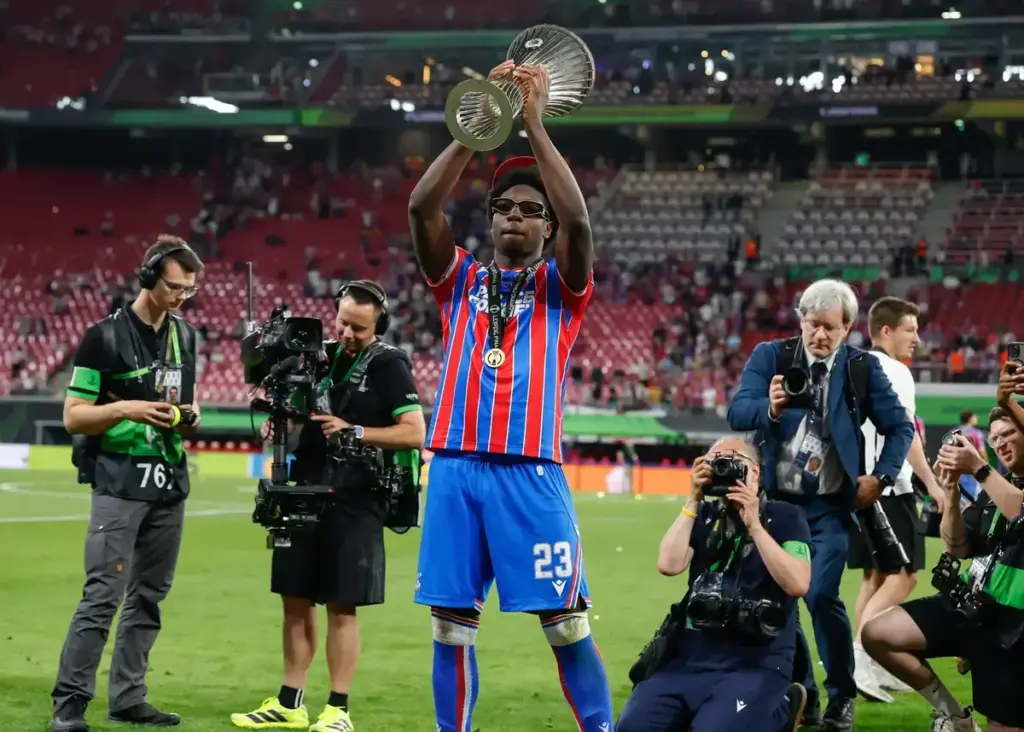
At some point, one of those players has to stay long enough to lift something bigger. The Conference League final in Leipzig tonight is a reminder of how close this club now is to genuinely mattering on the European stage. Whether that proximity translates into staying power is the only story that really matters at Selhurst Park right now.




Comments.
Loading comments…