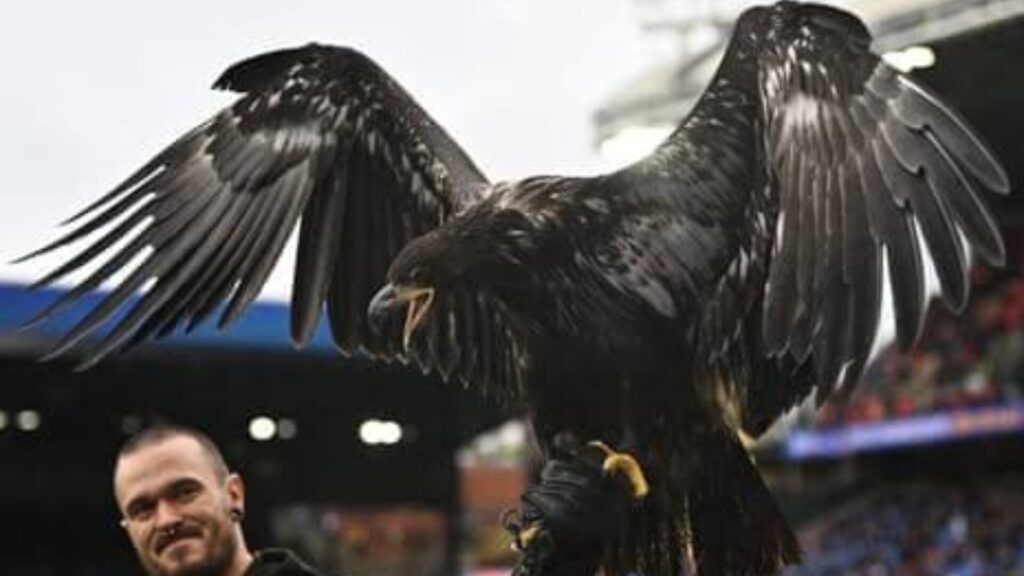

Crystal Palace has been asked to retire the live bald eagle mascot Phoenix. Animal rights group PETA took up the case of a fan who complained about the club’s use of a bird for matchday entertainment.
PETA has contacted the Palace Chief Executive, Sharon Lacey. They argued that the club must stop this practice altogether and vow not to use a live animal mascot again.
The campaign has brought back the controversy surrounding one of the most controversial traditions in football. It’s raised many questions regarding animal welfare in contrast to the role of the eagle in the identity of the club.
Phoenix hasn’t become a regular feature of matchdays. It was supposed to appear for the first time in August 2024 but was said to have abandoned the plan to fly across Selhurst Park. She has not been at the stadium since her first appearance.
Why PETA wants Crystal Palace to retire Phoenix
PETA believes that the noise of the football ground, bright lights and crowds can cause birds to become frightened and disoriented. The campaign group’s representative, Dr Carys Bennett, said Crystal Palace already has its costumed mascot, Pete the Eagle. PETA have called on the club to permanently retire Phoenix from matchday duties.
The concerns are part of a PETA campaign but do not prove that Phoenix has been harmed by the club.
Phoenix came from Eagle Heights Wildlife Foundation in Kent in August 2024, replacing Kayla, the bald eagle who starred at Palace games from 2010 until her passing in 2020.
Crystal Palace’s eagle tradition dates back decades
Crystal Palace took up the Eagles nickname in 1973 under the guidance of manager Malcolm Allison who borrowed it from the Portuguese Benfica.
The tradition of a live eagle was started in 2010 when Kayla began to appear on the pitch. Quickly becoming a beloved mascot for the club. However, PETA reported several mishaps that occurred with the bird. These included an alleged assault incident involving thrashing crowds at a League Cup match versus Charlton Athletic in September 2015.
The group has also highlighted birds colliding with stadium structures and a falcon injuring a spectator. These incidents do not prove Phoenix would face similar risks. However, PETA argues they show why live animals should not be used for entertainment at football grounds.
Will Crystal Palace abandon its live mascot tradition?
For Palace, the dilemma was whether a live eagle was needed to depict the club’s identity. The supporters felt that it should be continued as part of its history. PETA believes that the badge and the costumed mascot Pete the Eagle can achieve the same goal.
Palace has not revealed whether there will be a permanent ban on the phoenix on their home ground or not.
The issue arose after Palace’s 5-0 loss to Brighton, with Oliver Glasner’s men set to face Besiktas in the Europa League on Thursday.
PETA has called on the club to pledge itself to animal welfare by banning the use of live eagle mascots for good.
Whether the club responds by changing its approach remains to be seen.








Comments.
Loading comments…