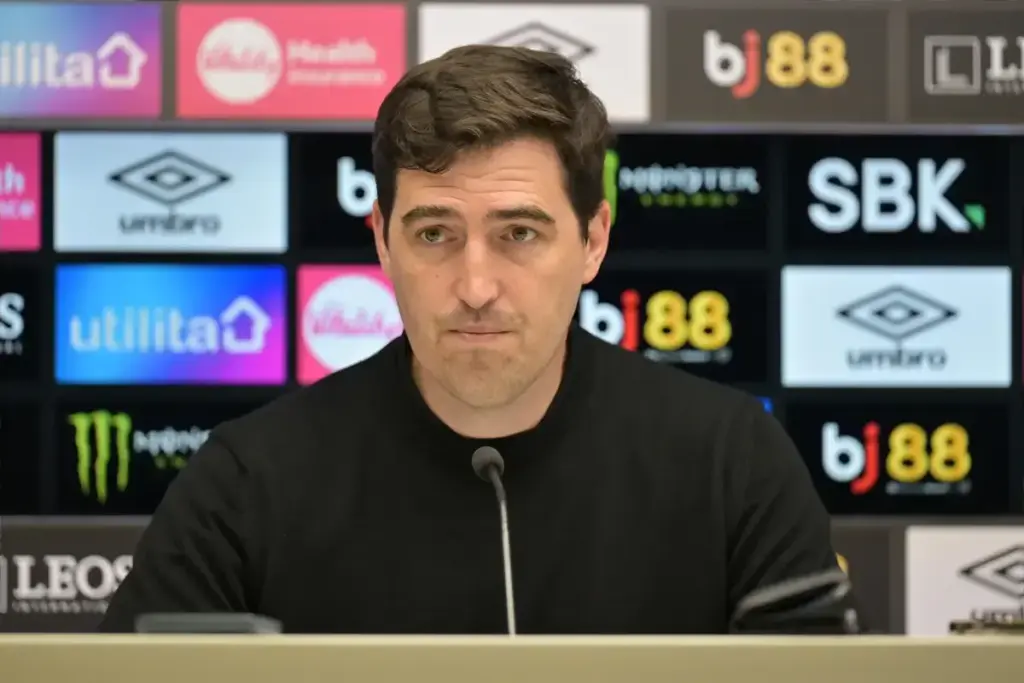

- Iraola’s thoughts on penalty decision
- Why it was the wrong call
- Did it have an impact on the result?
Crystal Palace lost 3-0 to Bournemouth at the Vitality Stadium on Sunday afternoon, the Cherries extending their unbeaten run to fourteen games, the longest of any club side in Europe’s top five leagues. Their second goal came from the penalty spot, a decision which caused a stir online.
A heavily rotated Palace side deserved little more than the 3-0 beating they received down on the South Coast. Unimaginative, lacklustre and reserved, it was not a Palace performance that will be remembered for any good reason.
Whilst Bournemouth were good value of their win, the scoreline, and game, was ultimately decided by a refereeing decision which manager Andoni Iraola described as ‘soft’.
The decision analysed
Dean Henderson rose to claim an aerial ball. As he landed, he lost control of the ball and dropped it forwards, with Bournemouth central defender Marco Senesi stepping between ‘keeper and ball. In an attempt to clear, Henderson lunged for the ball, and whilst he didn’t make contact, Senesi stepped across and went down.
Referee Rob Jones pointed to the spot almost immediately. It was one of the many decisions that, upon first replay, you simply assume will be overturned. After all, that’s what VAR was introduced to do.
There is simply next to no contact between Henderson and Senesi, at least not enough to warrant the Argentine falling to the turf in the manner that he did.
Despite clear replays from numerous angles, including the front-facing view from which the referee would have seen the incident, it was clear that, if anything, Senesi tripped himself up.
However, despite this, the VAR deemed there was no ‘clear and obvious error’. This definition felt crucial upon the introduction of video assisted refereeing, but has not been followed in any measure, in Europe or in the Premier League.
Awarding a penalty when there is not enough contact to warrant such a decision, is surely, by every definition, a clear and obvious error. A spot-kick is just about the most significant decision a referee can make, and therefore VAR’s decision not to step in left the wider footballing world, let alone Palace fans, dumbfounded.
Bournemouth manager Andoni Iraola, who has been linked to the upcoming vacancy at Selhurst Park, shared his thoughts on the decision after the game.
“I think it’s a very soft penalty. Very soft.”
Iraola said that he knew the decision would not be overturned because of the minimal contact made, however seemed to accept that it was ultimately the wrong decision.
Did the decision impact the result?
In all honesty, the lack of intervention from the VAR likely didn’t impact the final result in any sense aside from the scoreline.
Jefferson Lerma had converted into his own net to put Bournemouth 1-0 up, just 10 minutes into the game.
The penalty, which Eli Junior Kroupi converted, meant the Cherries had a two goal lead at halftime.
Despite a consistent attacking threat from Bournemouth across the ninety minutes, they only forced relatively routine saves from Dean Henderson.
Rayan’s strike late on sealed the win, and was the only time that Iraola’s side had actually done enough themselves to score one of their three goals.
Palace were toothless, but Ismaila Sarr hit the post in the 89th minute, which was the closest Palace came to a goal.
Ultimately, the decision did not change the result too much, but it did serve as the killer blow in that first half.
All fans ask for is consistency, and the general outrage at this decision suggests that it simply was just another bad call from an official who has made a handful of those when officiating Palace this season.





Comments.
Loading comments…