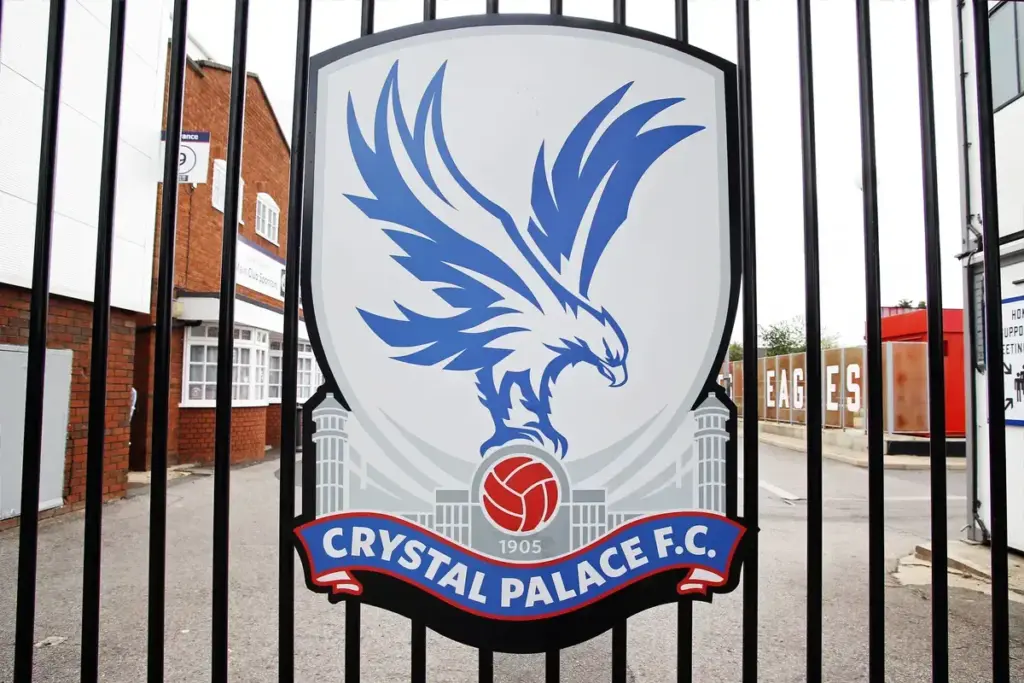

- Delve into the history of the Crystal Palace logo
- How it has evolved throughout time
- Why it is so significant
For a club nicknamed The Eagles, it might surprise casual football fans to learn that Crystal Palace didn’t actually start out with an eagle on their chest.
The evolution of the club’s crest is a fascinating journey that mirrors the team’s identity shifts, its physical relocation, and a radical 1970s rebrand that changed the club’s face forever.
Here is the story of how a Victorian exhibition building transformed into one of the most striking modern emblems in English football.
Crystal Palace logo origins (1905–1973)
When Crystal Palace FC was formed in 1905, its identity was inextricably linked to the massive cast-iron-and-glass Crystal Palace Exhibition Building in Sydenham, where the club originally played.
The earliest iterations of the club crest featured a detailed, intricate illustration of the famous glass palace pavilion itself. For nearly seven decades, variations of this building dominated the club’s imagery. It represented the Victorian engineering marvel that gave the team its name.
Because of this association with the glass structure, the team’s original nickname was The Glaziers. The crests during this long era were traditional, highly detailed, and heavily focused on local architectural pride.
Malcolm Allison revolution: Enter The Eagles (1973)
The year 1973 marked the biggest transformation in the club’s history, orchestrated by flamboyant manager Malcolm Allison. Allison wanted to completely modernise the club’s image, strip away the “Glaziers” moniker, and introduce a persona that felt fierce and aggressive.
The Rebrand: Allison looked to Portuguese club Benfica for inspiration. He changed the club’s colours from the traditional claret and blue to the bold red-and-blue vertical stripes we know today.
Out went the glass building as a primary focus, and in came The Eagles. The new logo introduced a stylised, aggressive eagle clutching a football. While the traditional Crystal Palace building was kept as a small graphic element beneath the eagle’s talons, the bird of prey was now the undisputed star of the show.
Streamlining the Eagle (1987–2022)
As football entered the Premier League era in the 1990s and 2000s, logos needed to become cleaner and more adaptable for digital broadcasting, merchandise, and global marketing.
The crest was updated to a more defined, corporate, yet powerful aesthetic. The eagle was rendered in a striking, dynamic pose, swooping over a minimalist representation of the Crystal Palace glass dome.
In the late 1990s, the club briefly experimented with simpler, rounder badge variations and stylised typography, but the core imagery of the eagle perched atop the palace remained the club’s definitive symbol.
The Modern era & founding year correction (2022–Present)
The most recent major update to the crest occurred in 2022, following extensive historical research that reshaped the club’s official narrative.
Researchers established a direct link between the professional club formed in 1905 and the original Crystal Palace cricket/football club set up by team cricketers in 1861. This made Crystal Palace the oldest professional association football club in the world.
To celebrate this heritage, the club officially changed the founding year displayed at the bottom of the crest from 1905 to 1861.
The eagle was given sharper, cleaner lines, and the colours were boosted for maximum vibrancy on digital screens, ensuring the club’s historic past and bold future perfectly align.
Why the crest matters today
The Crystal Palace logo is widely regarded as one of the best in the Premier League because it successfully balances two vital elements of a football club’s identity: heritage (the Victorian glass palace) and modern branding (the striking eagle).
Whether you call them the Glaziers or the Eagles, the crest remains a proud symbol of South London pride.






Comments.
Loading comments…